Devaney Pate Morris & Cameron LLP Secures Major Victory: Ninth Circuit Affirms Defense Verdict in Complex False Claims Act Case
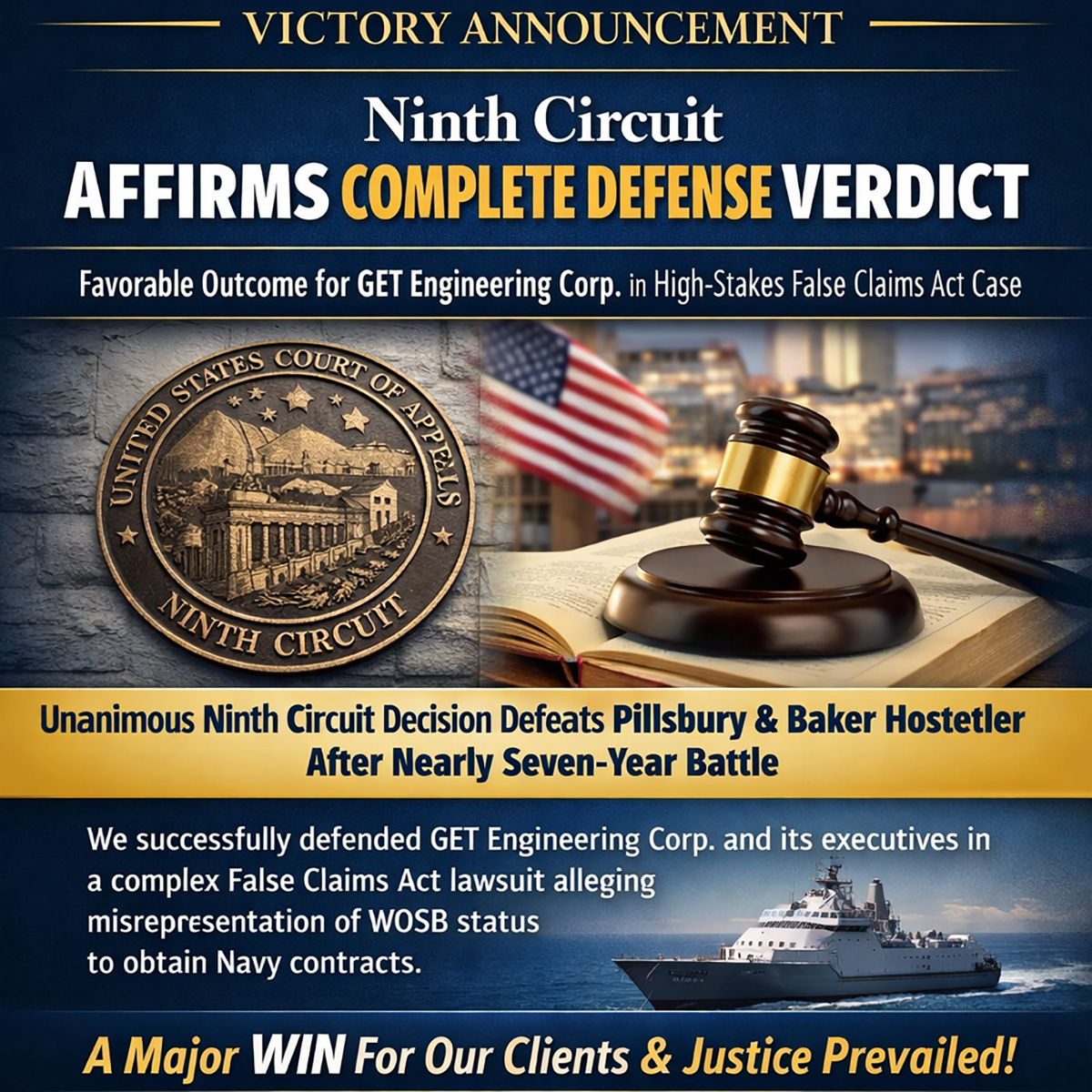
Devaney Pate Morris and Cameron LLP is proud to announce a significant legal victory. The Ninth Circuit Court of Appeals unanimously affirmed a complete defense jury verdict in favor of our clients, GET Engineering Corp. and several individuals, in a hard-fought False Claims Act lawsuit that spanned nearly seven years against two of the largest law firms in the world, Pillsbury Winthrop Shaw Pittman and BakerHostetler.
The case represents one of the most complex and vigorously contested False Claims Act disputes between small-business defense contractors in recent years. The lawsuit centered on allegations that our client, a military defense contractor specializing in naval tactical data systems for U.S. Navy combat ships, had misrepresented its status as a women-owned small business (WOSB) to secure government contracts.
After an eight-day jury trial in the United States District Court for the Southern District of California, the jury returned a unanimous verdict in favor of GET Engineering Corp. and all individual defendants on all claims.The Ninth Circuit’s affirmation of that verdict validates not only the jury’s careful consideration of the evidence, but also the trial court’s handling of numerous complex legal and evidentiary issues throughout the proceedings.
Attorneys William Pate and Pamela Naughton handled the trial with assistance from Lesley Ionescu, Ralph Hicks, and David Plancarte.
A Dispute Between Defense Contractors Over Legacy Technology Vital to the United States Navy
The case arose from intense competition in a highly specialized market. Both the plaintiff (a direct competitor) and our client manufacture naval tactical data systems – sophisticated communication systems that are critical to the operation of U.S. Navy combat ships. These systems represent niche technology requiring specialized expertise and rigorous quality standards.
The dispute began when the plaintiff, acting as a qui tam relator under the False Claims Act, alleged that GET Engineering had fraudulently misrepresented itself as a women-owned small business between 2009 and 2015, and that allegedly was the reason it was able to secure government contracts. The United States government declined to intervene in the case, leaving the relator to pursue the litigation independently represented by large private law firms who ultimately lost the case.
The Core Issue: Corporate Titles vs. Substance
There was no dispute GET Engineering was always majority-owned by a woman, the late Guille Tuttle since the company was founded in 1982. At the heart of this case was the legal definition of “women-owned small business” under federal regulations– the Federal Acquisition Regulation (FAR) and the Small Business Administration (SBA) regulations. The case was complicated by the fact that Ms. Tuttle faced significant health challenges during the relevant period, requiring her to balance active engagement in the business with managing lupus, a chronic autoimmune condition. Since the 1980’s the company employed the same two women in managerial roles who played significant operational roles for over thirty years.
The defendants argued that they reasonably believed the company satisfied WOSB requirements based on the totality of the ownership and management structure, even if formal titles didn’t perfectly align with regulatory language that had evolved over time.
Trial Strategy and Evidence
The eight-day trial required careful presentation of highly technical evidence. The defense presented detailed testimony about the company’s operations, demonstrating Ms. Tuttle’s active involvement in strategic decisions, vendor relationships, customer interactions, and operational oversight – even when she didn’t hold the CEO title.
Both parties presented competing interpretations of the applicable FAR and SBA regulations. The court noted that “there appears to be a great deal of confusion as to which statutory and/or regulatory definition(s) of a WOSB controls here, both because there are several definitions and because the majority of those definitions have been amended during the course of the relevant conduct.”
A critical element of any False Claims Act case is proving that the alleged misrepresentation was “material.” The defense successfully challenged whether the plaintiff proved materiality, particularly given that the plaintiff called no customers or contracting officers to testify that the WOSB representation actually influenced their contracting decisions. Defense witnesses testified that GET Engineering was the preferred vendor based on the fact their products were better and more reliable systems the Navy has continued to rely on for over forty years.
The defense also presented evidence that the defendants reasonably believed they were in compliance with WOSB requirements based on their understanding of the regulations and their company’s actual ownership and management structure.
The court declined to give plaintiff’s requested instruction on the “presumed loss rule” – a regulation that would have allowed the jury to presume damages equal to the full contract amounts under certain circumstances. The court found insufficient evidence that the contracts at issue were “set aside, reserved, or otherwise classified as intended for award to” WOSBs, which is a prerequisite for applying the presumed loss rule.
Takeaways
The Ninth Circuit’s disposition represents the final chapter in this lengthy legal battle, providing complete vindication for GET Engineering Corp. The case underscores the genuine complexity of compliance with small business certification requirements. When regulations contain ambiguity or have evolved over time, good-faith efforts to comply; even if ultimately imperfect; may not constitute knowing fraud under the False Claims Act. As the district court noted, there was “a great deal of confusion” about which definitions applied and how they should be interpreted. This complexity is a significant factor in assessing whether a company acted with the scienter (knowledge or intent) required for False Claims Act liability.
In this case, the plaintiff’s failure to present testimony from any government customer or contracting officer about the materiality of the WOSB representation proved fatal.
In addition, the fact that this lawsuit was brought by a direct competitor, rather than by the government itself (which declined to intervene), likely influenced the jury’s decision. The defense highlighted the competitor-driven nature of qui tam litigation, likely inviting heightened scrutiny regarding both the merits and the motivations behind the lawsuit.
The Defense Team’s Approach
Devaney Pate Morris & Cameron, LLP’s successful representation of GET Engineering Corp. involved several key strategic elements. From the outset, we recognized that this case involved both complex legal questions about regulatory interpretation and disputed factual questions about the company’s actual operations and management structure.
Comprehensive Motion Practice: We argued extensively at the summary judgment stage, obtaining partial summary judgment on certain issues while positioning the case favorably for trial.
Aggressive but Fair Discovery: While vigorously defending discovery disputes, we also called attention to the plaintiff’s discovery failures, which ultimately limited their ability to present certain evidence at trial.
Clear Trial Theory: We presented a coherent narrative to the jury: that our client was genuinely majority-owned and controlled by a woman; that the regulatory requirements were genuinely ambiguous and confusing; and that defendants reasonably believed they were in compliance.
Technical and Human Elements: We balanced presentation of technical regulatory details with the human story of a family-owned business, the challenges faced by the woman owner, and the quality products the company provided to the Navy for decades.
Devaney Pate Morris & Cameron, LLP’s successful defense of GET Engineering Corp. through trial, post-trial motions, and appeal represents a significant achievement in False Claims Act litigation. The case demonstrates our firm’s capabilities in handling complex, high-stakes litigation involving government contracts, regulatory compliance, and competitor disputes. The complete defense verdict, sustained through all post-trial challenges and affirmed by the Ninth Circuit, provides our client with full vindication and allows them to continue their important work providing critical tactical combat systems to the U.S. Navy.
We are honored to have represented GET Engineering Corp. through this challenging litigation and proud of the result achieved for our client.
Need Assistance with Government Contract Compliance or False Claims Act Defense?
Devaney Pate Morris & Cameron Law has extensive experience representing government contractors in compliance matters, bid protests, contract disputes, and False Claims Act defense. Our attorneys understand both the technical requirements of government contracting and the high-stakes litigation that can arise when compliance is challenged.
Our team has the expertise to protect your interests and your business.
Contact William C. Pate by filling your contact form or call 619-354-5030 to discuss your government contracting needs.
This article is intended for informational purposes only and does not constitute legal advice. The information provided is general in nature and may not apply to your specific situation. For advice regarding your particular circumstances, please consult with a qualified attorney. This article discusses matters of public record, including a published court decision. No confidential or protected information has been disclosed.
About the Author:
William C. “Bill” Pate is a founding partner at Devaney Pate Morris & Cameron and has represented government contractors and public agencies in complex litigation since 2000. He has extensive experience with False Claims Act defense, government contract disputes, and high stakes civil litigation. His trial experience includes jury trials, arbitrations, and administrative proceedings, and his appellate work includes a once precedent-setting victory in the California Supreme Court. He can be reached on our website.
Devaney Pate Morris & Cameron Law | 402 W. Broadway, Suite 1300, San Diego, CA 92101 | 619-354-5030 | www.dpmclaw.com