
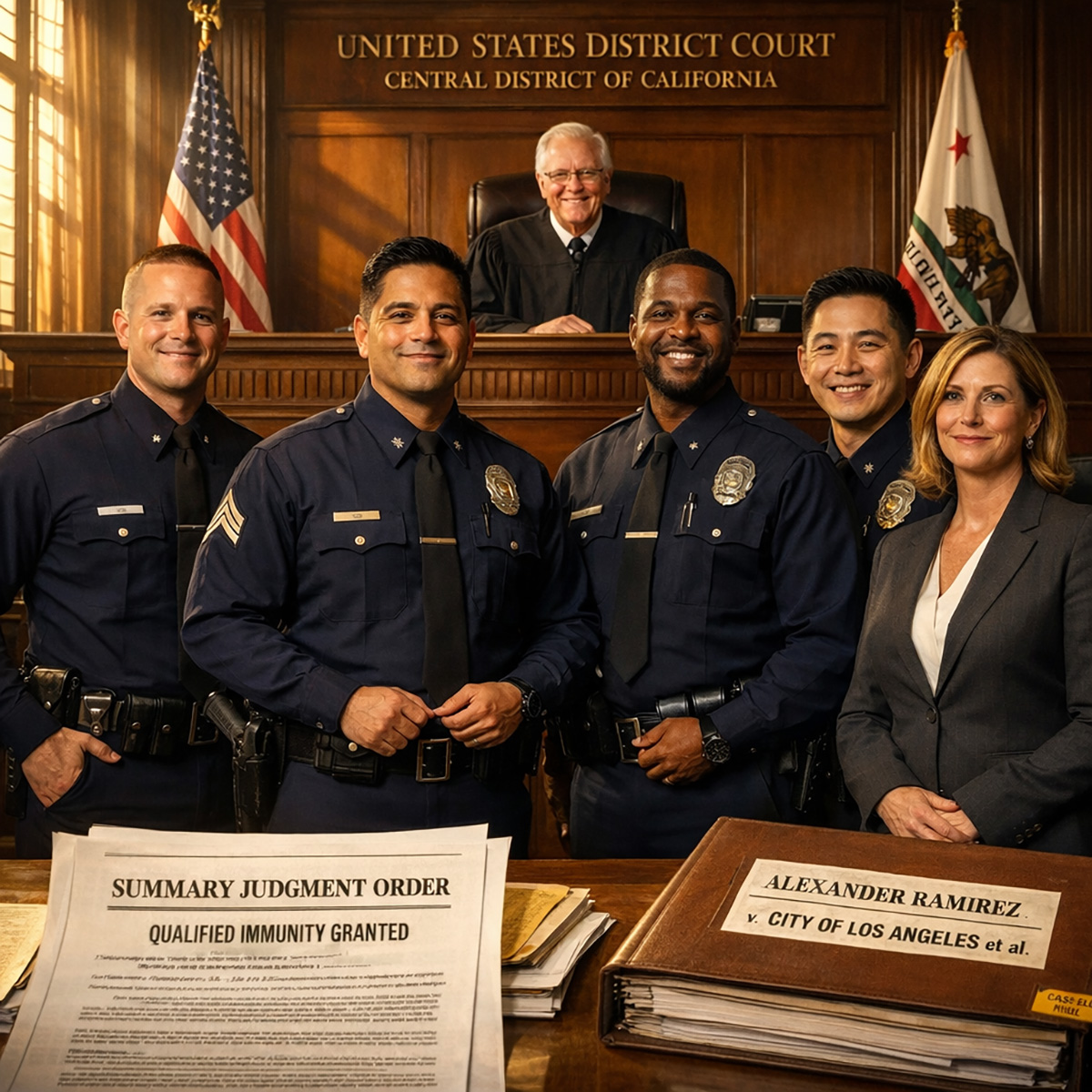
Devaney Pate Morris & Cameron LLP Successfully Defends two Los Angeles Police Department Officers As Court Grants Summary Judgment in Ramirez v. City of Los Angeles: A Comprehensive Analysis of Fourth Amendment, Qualified Immunity, and Monell Claims
Executive Summary
In a significant victory for law enforcement defendants, the United States District Court, Central District of California recently granted summary judgment in favor of the City of Los Angeles, the Los Angeles Police Department, and three individual officers in the civil rights case Alexander Ramirez v. City of Los Angeles et al. The Court’s comprehensive ruling addressed critical issues at the intersection of Fourth Amendment jurisprudence, qualified immunity doctrine, and municipal liability under Monell v. Department of Social Services.
This decision reinforces important precedents regarding the lawful scope of traffic stops, pat-down searches, arrests based on probable cause, and the high evidentiary burden plaintiffs face when asserting municipal liability claims. The ruling also illustrates the robust protection qualified immunity affords to law enforcement officers acting within the bounds of established constitutional law.
Case Background
Plaintiff Alexander Ramirez filed a civil rights lawsuit under 42 U.S.C. § 1983 against the City of Los Angeles, the LAPD, and three individual police officers. Mr. Ramirez alleged violations of his Fourth and Fourteenth Amendment rights stemming from a traffic stop, subsequent pat-down search, and arrest. The complaint raised several constitutional claims:
- Unlawful seizure (traffic stop) in violation of the Fourth Amendment
- Unlawful search (pat-down) in violation of the Fourth Amendment
- Unlawful arrest in violation of the Fourth Amendment
- Evidence fabrication in violation of the Fourteenth Amendment’s Due Process Clause
- Municipal liability under Monell against the City of Los Angeles
After discovery, Defendants moved for summary judgment on all claims, arguing that the officers’ actions were constitutionally permissible and, alternatively, that they were entitled to qualified immunity. The City argued that the Monell claim failed both because there was no underlying constitutional violation and because Plaintiff could not establish the requisite policy, custom, or failure to train.
The Court’s Ruling: Summary Judgment Granted on All Claims
The Court granted Defendants’ motion for summary judgment in its entirety, concluding that no genuine dispute of material fact warranted trial and that Defendants were entitled to judgment as a matter of law on all claims. This comprehensive victory rested on three analytical pillars:
- No Fourth Amendment Violation: The officers acted lawfully at each stage of the encounter
- Qualified Immunity: Even if constitutional violations had occurred, the officers were protected by qualified immunity
- No Monell Liability: Absent an underlying constitutional violation, and lacking evidence of a municipal policy or custom, the City could not be held liable
Analysis of the Court’s Reasoning
I. Fourth Amendment Claims: The Traffic Stop
The first critical question addressed by the Court was whether the initial traffic stop violated the Fourth Amendment’s prohibition against unreasonable seizures. Under established Supreme Court precedent, particularly Terry v. Ohio and its progeny, a traffic stop is reasonable under the Fourth Amendment when officers have reasonable suspicion that a traffic violation or other criminal activity has occurred.
The Reasonable Suspicion Standard
The Court applied the objective reasonable suspicion standard articulated in Whren v. United States, 517 U.S. 806 (1996). Under Whren, the constitutional validity of a traffic stop does not depend on the actual motivations of the individual officers but rather on whether the circumstances, viewed objectively, justify the stop. As the Supreme Court held, “subjective intentions play no role in ordinary, probable-cause Fourth Amendment analysis.”
Application to the Facts
In this case, the Court identified two independent bases for reasonable suspicion:
First, the officers observed that the vehicle had excessively tinted windows, which provided a lawful basis for the traffic stop under California Vehicle Code provisions regulating window tinting. Traffic violations, even minor ones, provide sufficient justification for a lawful stop.
Second, and perhaps more significantly, the officers received information that the vehicle’s license plate had been reported stolen. This report alone provided reasonable suspicion of criminal activity—specifically, Vehicle Code Section 10802, which prohibits the display of evidence of registration obtained by fraud or assigned to another vehicle.
The Court rejected Plaintiff’s argument that the officers’ subjective motivations—if they existed—rendered the stop unlawful. Citing the clear mandate of Whren, the Court emphasized that constitutional reasonableness depends on objective circumstances, not the officers’ internal thought processes or ultimate intentions.
Key Holding: The traffic stop was constitutionally valid because the officers possessed reasonable suspicion based on observable traffic violations and the stolen license plate report. The Fourth Amendment was not violated at this initial stage of the encounter.
II. Fourth Amendment Claims: The Pat-Down Search
Following the lawful stop, officers conducted a pat-down search of Mr. Ramirez. The Court next analyzed whether this search violated the Fourth Amendment under the framework established in Terry v. Ohio, 392 U.S. 1 (1968).
The Terry Standard for Pat-Down Searches
Under Terry, officers may conduct a limited pat-down search for weapons when they have reasonable suspicion that the person stopped is armed and dangerous. This protective search serves officer safety interests and is justified even in the absence of probable cause for arrest. The inquiry is whether, based on the totality of circumstances, a reasonably prudent officer would be warranted in believing that their safety or the safety of others was in danger.
The Totality of Circumstances
The Court engaged in a careful totality-of-the-circumstances analysis, considering multiple factors that supported the reasonableness of the pat-down:
- High-Crime Area: The stop occurred in an area known for elevated rates of violent crime, including gun-related offenses. Courts have consistently recognized that the character of the area is a relevant consideration in the reasonable suspicion calculus.
- Nature of Suspected Criminal Activity: The initial stop was predicated in part on a stolen license plate report—a felony offense that suggested involvement in more serious criminal activity beyond a simple traffic violation.
- Officer Safety Concerns: The officers articulated legitimate safety concerns based on the circumstances. When Plaintiff initially showed reluctance to exit the vehicle, this hesitation reasonably heightened officer safety concerns.
- Context of the Encounter: The combination of nighttime conditions, the suspect nature of the vehicle registration, and the location all contributed to a reasonable belief that the officers’ safety required a protective frisk.
Qualified Immunity Analysis
Critically, the Court held that even if the pat-down search violated the Fourth Amendment—a conclusion the Court did not reach—the officers would be entitled to qualified immunity. Plaintiff failed to identify any clearly established law that would have put a reasonable officer on notice that the pat-down was unconstitutional under these specific circumstances.
Qualified immunity protects officers from liability unless their conduct violates “clearly established statutory or constitutional rights of which a reasonable person would have known.” Harlow v. Fitzgerald, 457 U.S. 800, 818 (1982). The Supreme Court has repeatedly emphasized that clearly established law must be defined with specificity—it is not enough that a general constitutional principle might be implicated. Rather, there must be a case with sufficiently similar facts to put officers on notice that their conduct was unlawful.
Here, Plaintiff could not point to binding precedent establishing that a pat-down under these particular circumstances—high-crime area, suspected felony, reluctance to comply—violated the Fourth Amendment. Accordingly, qualified immunity shielded the officers.
Key Holding: The pat-down search was reasonable under Terry, or alternatively, the officers were entitled to qualified immunity because no clearly established law prohibited the search under these specific factual circumstances.
III. Fourth Amendment Claims: The Arrest
The final Fourth Amendment issue concerned the lawfulness of Mr. Ramirez’s arrest. The Court applied the well-established probable cause standard governing arrests.
Probable Cause for Arrest
Probable cause to arrest exists when, under the totality of circumstances, officers have “reasonably trustworthy information” sufficient to warrant a prudent person in believing that the suspect has committed or is committing an offense. Beck v. Ohio, 379 U.S. 89, 91 (1964). The standard requires more than reasonable suspicion but less than proof beyond a reasonable doubt or even a preponderance of the evidence.
Application: Felon in Possession of a Firearm
The Court found that officers had probable cause to arrest Mr. Ramirez for being a felon in possession of a firearm—a violation of California Penal Code Section 29800 and federal law under 18 U.S.C. § 922(g). The factual record established that:
- Officers discovered a firearm during the encounter
- Officers learned that Mr. Ramirez had a prior felony conviction
- The combination of these facts established probable cause for the criminal offense of felon in possession
Rejection of the Fruit-of-the-Poisonous-Tree Argument
Plaintiff argued that the arrest was tainted because it was the product of an allegedly unlawful prior search and seizure. Plaintiff sought to invoke the “fruit of the poisonous tree” doctrine, which typically excludes evidence obtained through Fourth Amendment violations in criminal proceedings.
The Court rejected this argument, citing controlling Ninth Circuit precedent. The Ninth Circuit has held that the fruit-of-the-poisonous-tree doctrine does not apply in civil rights actions under 42 U.S.C. § 1983. See Larson v. Domestic & Foreign Commerce Corp., 337 U.S. 682 (1949); Townes v. City of New York, 176 F.3d 138 (2d Cir. 1999).
The rationale for this rule is straightforward: § 1983 actions focus on the constitutional reasonableness of each discrete act by government officials, not on the admissibility of evidence in criminal proceedings. The exclusionary rule serves to deter unlawful police conduct by suppressing evidence in criminal trials; it does not provide a basis for civil liability when officers had probable cause to arrest based on information lawfully in their possession—regardless of how that information was obtained.
In this case, the officers possessed information establishing probable cause (the firearm and the prior felony conviction). Whether that information was discovered through a prior constitutional violation was irrelevant to the probable cause analysis in the § 1983 context.
Key Holding: The officers had probable cause to arrest Mr. Ramirez for being a felon in possession of a firearm. The fruit-of-the-poisonous-tree doctrine does not apply in § 1983 actions, so the arrest was lawful even assuming arguendo that prior constitutional violations had occurred.
IV. Fourteenth Amendment Claim: Evidence Fabrication
Mr. Ramirez also alleged that the officers violated his Fourteenth Amendment Due Process rights by fabricating evidence—specifically, by making inaccurate or misleading statements in their police reports regarding the circumstances of the stop, search, and arrest.
The Elements of an Evidence Fabrication Claim
To prevail on a fabricated evidence claim under the Fourteenth Amendment, a plaintiff must establish:
- The defendant officer deliberately fabricated evidence or made false statements
- The fabricated evidence or false statements were material
- The fabrication caused the plaintiff’s deprivation of liberty (such as criminal prosecution or continued detention)
The causation element is critical. Even if evidence was fabricated, the plaintiff must show that the fabrication actually caused a constitutional harm—typically, that it was the cause of the plaintiff’s prosecution or prolonged detention.
Failure to Establish Causation
The Court found that Mr. Ramirez failed to prove causation. Even assuming that certain statements in the police reports were inaccurate or misleading, Plaintiff could not demonstrate that these alleged inaccuracies caused his deprivation of liberty.
The Court reasoned:
- The officers had independent, lawful bases for the stop (reasonable suspicion based on tinted windows and stolen license plate)
- The officers had independent, lawful bases for the arrest (probable cause based on felon-in-possession evidence)
- The alleged fabrications did not create the reasonable suspicion or probable cause; rather, that suspicion and cause existed independent of any allegedly false statements
Because the constitutional justifications for the stop and arrest existed independently of the disputed statements in the police reports, those statements—even if false—could not have been the “but-for” cause of Plaintiff’s detention or prosecution.
Courts have repeatedly held that fabricated evidence claims require a showing that “but for” the fabrication, the plaintiff would not have been deprived of liberty. Here, Plaintiff’s liberty was lawfully restricted based on independent probable cause.
Key Holding: The evidence fabrication claim failed because Plaintiff could not establish that the allegedly false statements in the police reports caused his constitutional deprivation. The officers’ actions were independently justified by reasonable suspicion and probable cause.
V. Municipal Liability Under Monell
Finally, the Court addressed Mr. Ramirez’s Monell claim against the City of Los Angeles. Monell v. Department of Social Services of New York, 436 U.S. 658 (1978), established that municipalities can be held liable under § 1983, but only under specific circumstances that differ significantly from individual officer liability.
The Monell Standard
A municipality cannot be held liable under § 1983 on a respondeat superior theory—that is, a city is not automatically liable simply because its employee (a police officer) violated someone’s constitutional rights. Instead, plaintiffs must prove:
- An underlying constitutional violation occurred
- The violation resulted from:
-
- An official municipal policy
- A widespread custom or practice
- A decision by a municipal official with final policymaking authority, or
- A failure to train, supervise, or discipline that amounts to deliberate indifference
The Supreme Court has emphasized that Monell liability requires proof of a “direct causal link” between the municipal action (policy, custom, or failure to train) and the constitutional violation.
Absence of an Underlying Constitutional Violation
The Court’s Monell analysis began with a threshold issue: because the Court had determined that no constitutional violation occurred, there could be no municipal liability. Monell claims are derivative—they depend on establishing an underlying constitutional violation by a municipal employee.
Having found that the officers did not violate Mr. Ramirez’s Fourth Amendment rights and that the Fourteenth Amendment claim failed on causation grounds, the Court concluded that this alone defeated the Monell claim.
Insufficient Evidence of Policy, Custom, or Failure to Train
The Court went further, holding that even if a constitutional violation had occurred, Plaintiff failed to provide sufficient evidence of a City policy or custom, or of a failure to train that rose to the level of deliberate indifference.
No Evidence of Official Policy: Plaintiff did not identify any formal written policy of the City of Los Angeles that authorized or encouraged the allegedly unconstitutional conduct.
Insufficient Evidence of Custom or Practice: Establishing an unofficial “custom” requires proof of a practice so widespread and well-settled that it constitutes the functional equivalent of official policy. Plaintiff did not present evidence of a pattern of similar conduct sufficient to establish such a custom.
Isolated Incidents Insufficient: Plaintiff pointed to criminal charges filed against one of the defendant officers in an unrelated matter. The Court held that this evidence was insufficient to establish a City policy or custom. Isolated incidents or allegations against individual officers, standing alone, do not prove municipal liability. The Supreme Court has made clear that municipalities are not liable for the isolated misconduct of employees absent proof that the misconduct resulted from a policy or custom.
Failure to Train: Claims based on failure to train require proof that: (1) the municipality failed to train its employees adequately, (2) the failure amounts to deliberate indifference to the constitutional rights of those with whom officers interact, and (3) the failure caused the constitutional violation. See City of Canton v. Harris, 489 U.S. 378 (1989). Plaintiff presented no evidence regarding the City’s training programs, let alone evidence that any training deficiency amounted to deliberate indifference.
Key Holding: The Monell claim failed for two independent reasons: (1) there was no underlying constitutional violation, and (2) Plaintiff failed to present evidence of a City policy, custom, or failure to train that caused the alleged constitutional violations.
Legal Significance and Implications
This decision reinforces several important principles in civil rights litigation involving law enforcement:
1. Objective Standards Govern Fourth Amendment Analysis
The Court’s application of Whren underscores that Fourth Amendment reasonableness depends on objective circumstances, not officer motivations. This standard protects law enforcement’s ability to make traffic stops based on observed violations without concern that courts will second-guess their subjective intent. For civil rights practitioners defending law enforcement, this remains a powerful tool in defeating claims based on alleged pretextual stops.
2. Qualified Immunity Provides Robust Protection
The decision illustrates the substantial protection qualified immunity affords to officers whose actions fall within the bounds of reasonable professional judgment, even if those actions might later be found to violate the Constitution. The requirement that plaintiffs identify clearly established law with factual specificity creates a high bar that defeats many § 1983 claims on summary judgment.
3. The Fruit-of-the-Poisonous-Tree Doctrine Does Not Apply in § 1983 Actions
The Court’s rejection of Plaintiff’s fruit-of-the-poisonous-tree argument reinforces the important distinction between criminal and civil proceedings. In the § 1983 context, each government action is analyzed independently for constitutional reasonableness. This rule prevents plaintiffs from creating derivative civil claims based on evidentiary rules designed for criminal proceedings.
4. Monell Claims Require Substantial Evidence
The decision demonstrates the difficulty plaintiffs face in establishing municipal liability. Cities are not insurers of their employees’ conduct, and isolated incidents—even serious ones—do not establish the policy or custom necessary for Monell liability. This holding protects municipalities from liability absent proof of systemic problems.
5. Causation Matters in Fabricated Evidence Claims
Even if officers make false statements, plaintiffs must prove that those statements caused their constitutional harm. Where independent probable cause exists, fabricated evidence claims fail on causation grounds. This principle prevents § 1983 from becoming a general vehicle for litigating police report accuracy divorced from actual constitutional injury.
Takeaways for Law Enforcement and Municipalities
Litigation Strategy
- Move for Summary Judgment: Where the facts support it, early summary judgment motions can resolve cases efficiently and avoid the cost and uncertainty of trial.
- Lead with Qualified Immunity: Even where constitutional questions present close calls, qualified immunity provides an independent basis for dismissal when plaintiffs cannot identify clearly established law.
- Challenge Monell Claims Early: Municipal defendants should aggressively challenge Monell claims through motions to dismiss or summary judgment, requiring plaintiffs to produce specific evidence of policies, customs, or training failures.
Conclusion
The Court’s decision in Ramirez v. City of Los Angeles represents a comprehensive victory for law enforcement defendants and underscores the high burden plaintiffs face in § 1983 litigation. By carefully applying established Fourth Amendment standards, qualified immunity doctrine, and Monell principles, the Court demonstrated that summary judgment is appropriate where officers act within constitutional bounds and plaintiffs cannot meet their evidentiary burdens.
For law enforcement agencies and municipalities, this decision affirms that adherence to constitutional standards, proper training, and thorough documentation provide strong defenses against civil rights claims. For civil rights practitioners representing law enforcement, the decision offers a roadmap for successful defense of traffic stop, search, and arrest cases through summary judgment.
As civil rights litigation continues to evolve, decisions like this one serve as important reminders that constitutional protections for law enforcement—particularly qualified immunity and objective Fourth Amendment standards—remain robust tools for defending against claims that lack both factual and legal merit.
About the Author
Lesley Ionescu is an attorney at Devaney Pate Morris and Cameron, where she represents law enforcement agencies, municipalities, and public entities in civil rights litigation, employment disputes, and regulatory matters. She has extensive experience defending § 1983 claims and achieving favorable outcomes for her clients through motion practice and trial.
For questions about this case analysis or civil rights defense matters, please contact William Pate or Lesley Ionescu at Devaney Pate Morris and Cameron.
This blog post is provided for informational purposes only and does not constitute legal advice. The analysis presented reflects the author’s interpretation of the court’s decision and should not be relied upon as a substitute for consultation with qualified legal counsel regarding specific legal matters.
By William C. Pate and Lesley A. Ionescu
Devaney Pate Morris and Cameron LLP
Excellence in Public Entity Defense | Civil Rights Litigation | Employment Law
© 2026 Devaney Pate Morris and Cameron. All rights reserved.